FIRST / WHAT THE PEOPLE STUDIES FOUND
What is the short answer on CJC-1295?
After one shot, average growth hormone was about 46% higher. The growth protein IGF-1 was about 45% higher. Half the long form cleared in 5.8-8.1 days. A later Phase 2 study stopped.
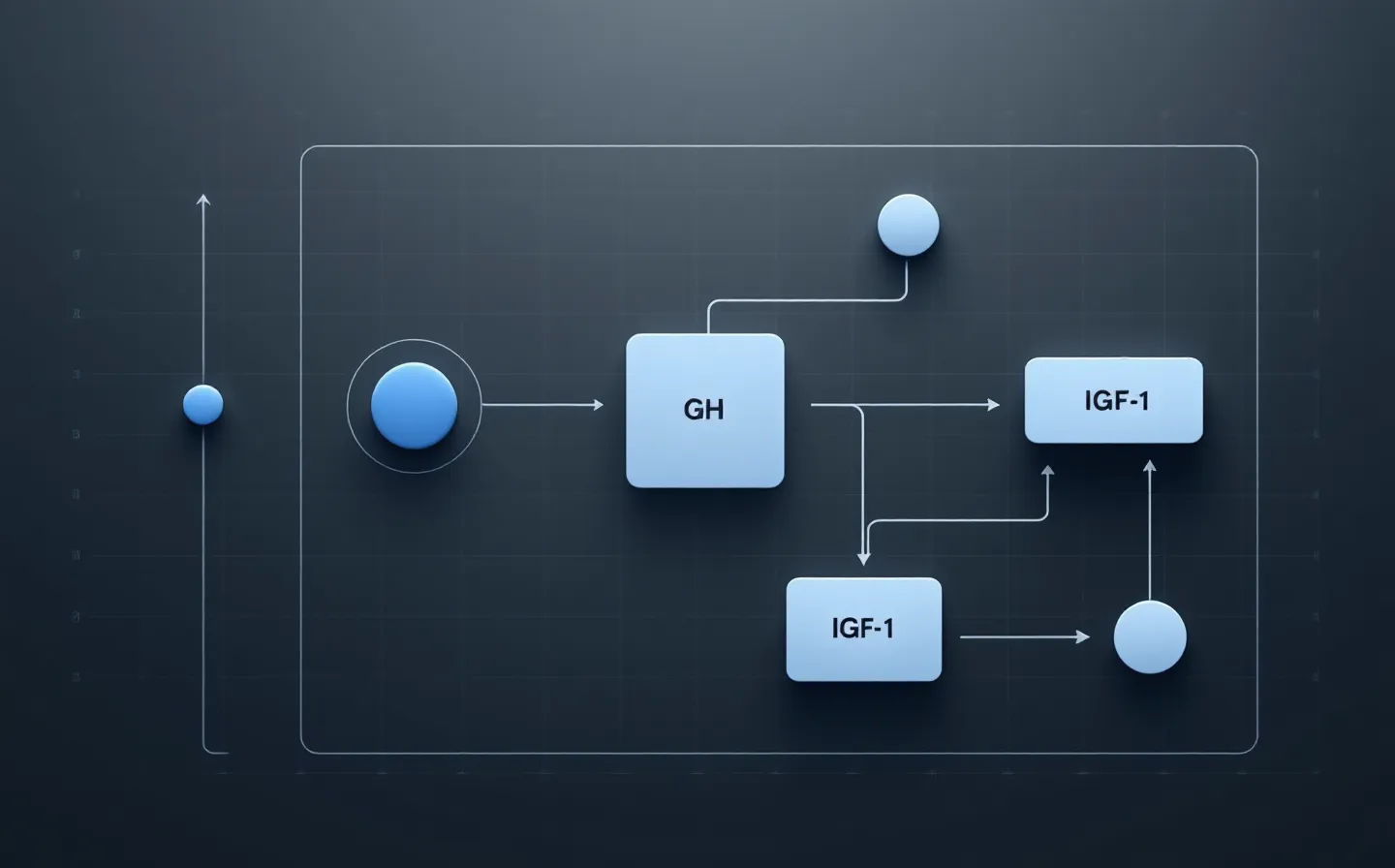
Which CJC-1295 results came from people and animals?
CJC-1295 has a peptide chain made from 29 amino acids, the small parts that form proteins [2]. The chain copies the body's note to the growth gland. The gland answers by releasing growth hormone. That part count identifies the drug; it doesn't prove safety.
The first CJC-1295 people study was small. Healthy adults received 30 or 60 ug/kg once. The amount meant millionths of a gram for every kilogram a person weighed. Growth hormone rose 2- to 10-fold, meaning the result ranged from twice its start to ten times its start. IGF-1 rose 1.5- to 3-fold, meaning from its starting point plus half to three times its start; half the long form cleared in 5.8-8.1 days [1].
A second CJC-1295 study enrolled healthy men aged 20-40. Each man received 60 or 90 ug/kg once. Average growth hormone was about 46% higher. IGF-1 was about 45% higher after one week, while normal daily rises continued [3].
Animal tests of CJC-1295 came first. In rats, the two-hour growth-hormone total was 4-fold higher than with the unaltered body message. The drug remained in their blood after 72 hours [2]. In mice lacking that body message, 2 ug every 24 hours restored normal weight and length [4].
The maker later opened a Phase 2 study. This wider early test enrolled people with HIV-associated belly fat. The study stopped [7], and CJC-1295 isn't approved for people. The next pages list the study amounts and named sources.
What is CJC-1295?
<a id="what-is"></a>
Which body message does CJC-1295 copy?
CJC-1295 begins with part of the body's growth message. Four of the chain's parts were changed. Those parts resist the body's cleanup proteins [2]. The drug may then remain in blood longer, but that doesn't prove safety.
How does CJC-1295 affect the growth gland?
CJC-1295 reaches the growth gland and causes growth-hormone release. That hormone raises IGF-1, a protein measured in blood. In healthy men, average growth hormone was about 46% higher. IGF-1 was about 45% higher one week later [3].
Why does CJC-1295 with DAC remain longer?
The letters DAC name a joining part on the long form. That part fastens the drug to albumin, a main blood protein. Half the drug cleared from blood in 5.8-8.1 days [1]. One shot kept IGF-1 raised past one week.
Is CJC-1295 only meant for research?
<a id="research-peptide"></a>
A peptide is one kind of short protein chain. This drug is a peptide, not a steroid or blend. Papers describe how its chain was made [2]. Its make-up alone can't show benefit or harm.
Your stomach breaks such chains apart. The studies therefore gave CJC-1295 by shot [1]. No form has approval for people. Brief, early studies can't settle lasting safety or better health.
What have people said in personal reports?
People have shared good and bad personal reports. These reports are not findings from a study that compared groups. The personal reports page keeps those claims apart from known safety concerns.