03 / THE LONG AND SHORT FORMS
CJC-1295 DAC vs no DAC: why does the DAC form stay longer?
DAC names a joining part on the long form. That part fastens the drug to albumin in blood. The no-DAC form clears within minutes to hours.
CJC-1295 DAC vs no DAC: what sets them apart?
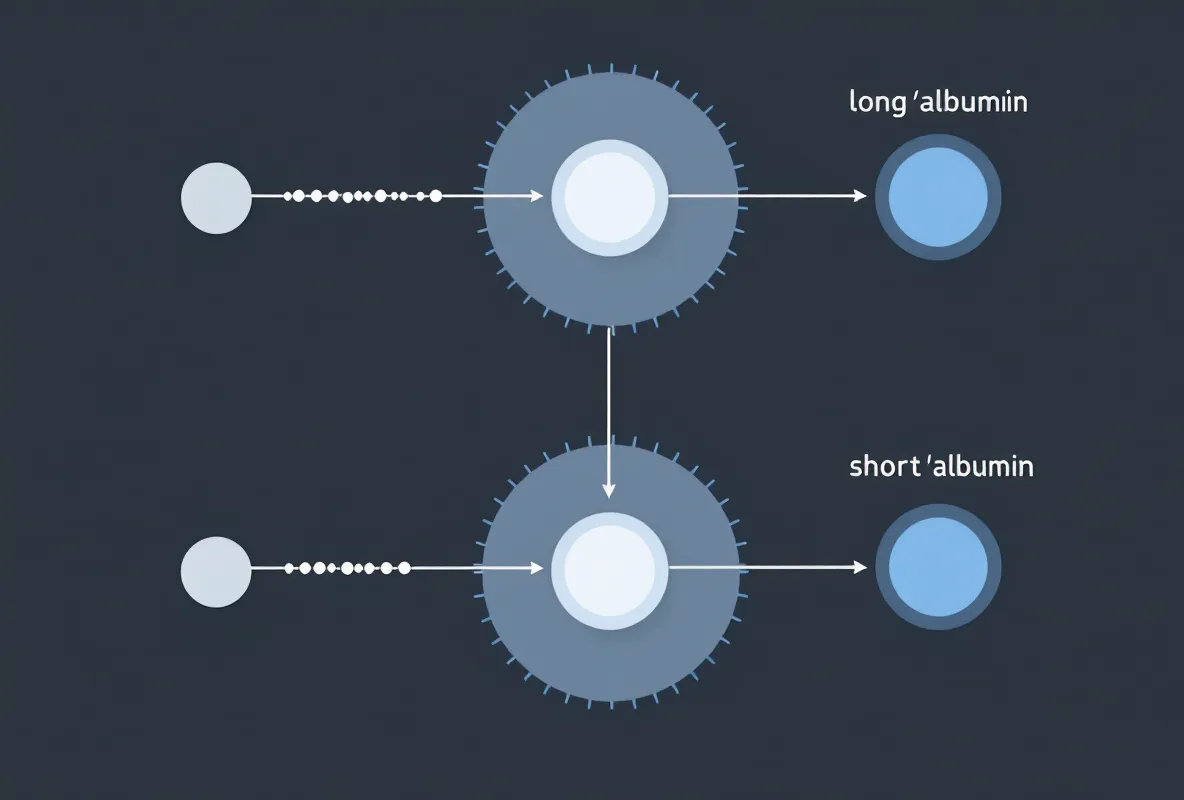
DAC is the joining part found only on the long form [2][16]. It fastens CJC-1295 to a blood protein called albumin. The no-DAC form lacks that part. Both forms share one short chain, with four altered spots that resist fast breakdown [2].
The albumin bond accounts for the large time gap. In healthy adults, half the DAC form cleared in 5.8-8.1 days. After one shot, IGF-1 remained raised for 9-11 days [1]. No-DAC clears within minutes to hours because albumin doesn't carry it [16].
Either form may bear the CJC-1295 name. That name won't tell you which form is inside. The label needs to say DAC or no-DAC. Without that word, a claim about time has no firm meaning.
What makes CJC-1295 DAC last for days?
<a id="what-dac-is"></a>
Why is CJC-1295 DAC called the long form?
The DAC part fastens CJC-1295 to albumin. Half the long form cleared in 5.8-8.1 days [1][16]. No-DAC lacks that joining part. Without the bond, no-DAC remains for far less time.
A kilodalton is a protein weight unit, much as a pound is for people; the joined pair weighs about 66 kilodaltons, while the free chain weighs about 3.4 kilodaltons [2]. The larger joined weight helps explain slower clearing from blood. Neither weight tells you whether the form is safe.
Only the DAC form has published people studies [1][3]. Its maker then opened a wider Phase 2 study. The study stopped [7]. The long form never became an approved drug.
Why is no-DAC the short form?
<a id="modified-grf"></a>
Why does no-DAC clear sooner?
No-DAC lacks the joining part carried by DAC. Four altered spots still help it resist fast breakdown [16]. Those spots cannot hold the drug in blood for days. This short form is also called CJC-1295 without DAC.
After no-DAC enters blood, its drug level rises briefly and then falls [16][2]. The 5.8-8.1 day time applies only to CJC-1295 DAC. The long growth-protein rise also came from DAC [1]. No matching result in people exists for CJC-1295 no-DAC.
This gap keeps the papers from being mixed together. A DAC result doesn't apply to no-DAC. Your source needs to name the form. If the form is missing, its time claim isn't sound.
Why can a label hide the form?
<a id="conflation"></a>
The same CJC-1295 name appears on both forms. Each also has four altered spots and reaches the growth gland [2]. A label showing only the shared name hides the key difference. The exact form and its likely time in blood remain unknown.
People studies of CJC-1295 tested DAC [1][3]. Earlier rat tests examined the albumin bond [2]. A lab later found CJC-1295 in a seized black-market product [6]. Testing the material was the only way to learn its exact form.
The maker studied CJC-1295 DAC in Phase 2. That test involved people with HIV-associated belly fat, then stopped [7]. No like-sized people study exists for no-DAC. The missing people study means no matching day-long result exists. Thus, old day-long results about DAC cannot be given to no-DAC.
Which label words tell the forms apart?
<a id="compare"></a>
Each form copies the body's growth message [2]. Each has four altered spots that slow breakdown [2]. Neither form has approval for people. Neither has a large safety study in people [7].
DAC binds albumin and remains longer. Half of the DAC form cleared in 5.8-8.1 days [1]. No-DAC lacks the bond and clears sooner [16]. The label must name DAC or no-DAC.
A no-DAC label means hours, not days. The blood-time page explains the measured result. The full reference list names its study. A label saying only CJC-1295 cannot answer your time question.